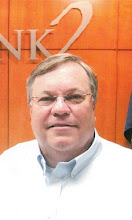
As you know, I was in NYC this past week attending the annual strategic planning meeting for The Bankers Bank. It was a great meeting. Tons of work. But Saturday afternoon I got to see the sights.
Things that stood out:
Central Park, if OKC's version of Central Park that is being build with the latest MAPS proceeds we are going to have one fantastic park! We took a late night guided bicycle tour that was great.
Time Square, the most incredible display of lighted billboards I have ever seen in my life. By law 18% of any building built in the area must be covered with electronic signage. WoW!
Empire State Building, wonderful design and details.
Ground Zero, the destruction is like nothing I had imagined, but it is all being rebuilt as a statement to the world that nothing or nobody can defeat the USA.
Subways, wonderfully efficient.
Trinity Church, in the middle of Wall Street, serves as a reminder that we are a blessed nation.
NYC Federal Reserve Bank gold vault, like no vault I have ever seen.
Gold Bar, I held one gold bar in my hands, 28 pounds, valued at $446,000!
Statue of George Washington on Wall Street in memory of where he took the oath of office as the first president of the USA. I will never forget it.
New York Stock Exchange, big, bold, stately and 100% all American.
Taxis, everywhere!
Statue of Liberty, breathtaking night and day!
It took me 57 years to make my first visit, what a mistake. I would encourage you to go to NYC. Yes the rooms cost too much, the food is too high as well, but you are missing one great city if you don't go.
Ross
Sunday, August 1, 2010

Thursday, July 29, 2010
Promises! Promises!
Another day of hard work! Rod Whitson, master strategic plan leader is putting us through the paces as we plan the next few years for The Bankers Bank. Great meeting.
Tonight we went to Sardi's for dinner and then off to Broadway. We saw Promises! Promises! It was a wonderful musical and comedy. Tons of fun.
Across the street was the David Letterman's Show, Hello Deli and that pizza place he is always featuring.
Work hard, play hard!
Ross
Harlem - Apollo Theater
Wow what a night!
Our good friends Kim and Marilynn Wheeler took us to the Apollo Theater last night. we road the subway out (that is another story) and arrive just a couple of blocks from the theater. We made the short walk through Harlem to the world famous theater.
Amateur night!
What a hoot!
If you are ever in NYC this is a Must Do.
Ross
Wednesday, July 28, 2010
So Much For Privacy!
Checking in at the airport today we had to use an electronic deal to check in. First you had to type your full name in. Then you had to type in your complete birthdate. Everyone within 10-15 feet could read the info.
We were told by the employees it was required by the government!
I did not like the system one bit!
Before we left town we had to drop by the post office. Out in front, in a prime location, is a FedX deposit box. I am not kidding! No wonder the postal service is loosing it's shirt.
Whoever dreams this stuff up is going to be dreaming up your health care and the new banking rules!
Ross
Tuesday, July 27, 2010
I Would Be In The Poor House
I think I mentioned that I was reading through the Bible from front to back. I am just entering Leviticus and I have to say that I am overwhelmed as I read the pages. It seems God's people were required to make all kinds of offering for their sin. The Bible is very specific about all of this. It might be good for you to read Leviticus to see what I mean.
As I reflected upon what I have been reading I am overwhelmed by my own sin. If I was alive at that time I would be at the tabernacle making offering(s) EVERYDAY. I wondered how I would have time to do anything else. I wondered how I would make money to acquire the things necessary to make the offering. I soon realized that I would be in the poor house because of my sin.
Then I Praised God for delivering the ultimate sacrifice His Son so that I may be forgiven. As I reflected more, I realized that all of the offerings that were required of God's people made them confront their sin directly. It cost them directly. It made them do without food and perhaps increase/income. It hurt to sin. You had to pay a price.
Today, I get complacent about my sin because it does not cost me anything immediately. The cost is more indirect. Because Jesus paid the ultimate sacrifice so I don't have to pay it. I am not loosing money, or time running around making sacrifices. Jesus paid my debt/my sacrifices once and for all. The question is, "what am I doing with the blessing Jesus has given to me?"
As I reflected upon what I have been reading I am overwhelmed by my own sin. If I was alive at that time I would be at the tabernacle making offering(s) EVERYDAY. I wondered how I would have time to do anything else. I wondered how I would make money to acquire the things necessary to make the offering. I soon realized that I would be in the poor house because of my sin.
Then I Praised God for delivering the ultimate sacrifice His Son so that I may be forgiven. As I reflected more, I realized that all of the offerings that were required of God's people made them confront their sin directly. It cost them directly. It made them do without food and perhaps increase/income. It hurt to sin. You had to pay a price.
Today, I get complacent about my sin because it does not cost me anything immediately. The cost is more indirect. Because Jesus paid the ultimate sacrifice so I don't have to pay it. I am not loosing money, or time running around making sacrifices. Jesus paid my debt/my sacrifices once and for all. The question is, "what am I doing with the blessing Jesus has given to me?"
Friday, July 23, 2010
American Banking Association- Worth Reading
Topic A: Nothing to Celebrate
By Ed Yingling, ABA President and CEO
Although I have been invited to the signing ceremonies of most major banking bills for the last 25 years, I should not have been invited to the one for the Dodd-Frank Act, and I was not.
The Administration has been more than generous in inviting me to meetings, speeches and bill signings. But, here, ABA opposed the Administration’s proposal throughout the legislative process (although there were parts we supported). A signing ceremony, particularly on a major priority like this, is ultimately a celebration, as a White House spokesperson noted. The White House said only supporters of the bill were invited. Only those who believe there is something to celebrate should attend.
This week ABA had a major meeting in Washington. Our board, Government Relations Administrative Committee, Membership Committee and the leadership of the state associations all discussed this bill. Everyone in attendance opposed it. In fact, I have not talked to a banker who did not oppose it. Core parts of the reform are needed, but -- just as we had feared from the beginning -- this law is loaded up with massive new regulatory requirements and social engineering.
There are so many new regulations -- hundreds -- that lawyers cannot even agree on the number. While not all apply to traditional banks, ABA has a low-ball estimate that more than 5,000 pages of new rules will apply to traditional banks. The new consumer bureau, many believe, is the most powerful bureau ever created in terms of its authority and lack of checks and balances. And then there is the Durbin interchange amendment. The new regulations are so overwhelming that they cannot possibly all be written on time. There will be great uncertainly about the rules for many aspects of our business for years to come, and our litigation risk is huge.
The end result will be massive new costs for all banks, but community banks will suffer the most because they lack the scale to absorb the new costs. Ultimately, the economy will suffer, and consumer and business products, particularly loans, will be less available and cost more. Mortgage lending is a prime example of where extensive new rules will apply that will take years to settle down.
This tsunami of requirements overwhelms the positives of the bill, which include a systemic oversight mechanism, a method for resolving systemically risky institutions, and new regulation of non-bank entities. For years to come, new regulations from the bill itself and from the consumer bureau will remind us of what the law did.
By Ed Yingling, ABA President and CEO
Although I have been invited to the signing ceremonies of most major banking bills for the last 25 years, I should not have been invited to the one for the Dodd-Frank Act, and I was not.
The Administration has been more than generous in inviting me to meetings, speeches and bill signings. But, here, ABA opposed the Administration’s proposal throughout the legislative process (although there were parts we supported). A signing ceremony, particularly on a major priority like this, is ultimately a celebration, as a White House spokesperson noted. The White House said only supporters of the bill were invited. Only those who believe there is something to celebrate should attend.
This week ABA had a major meeting in Washington. Our board, Government Relations Administrative Committee, Membership Committee and the leadership of the state associations all discussed this bill. Everyone in attendance opposed it. In fact, I have not talked to a banker who did not oppose it. Core parts of the reform are needed, but -- just as we had feared from the beginning -- this law is loaded up with massive new regulatory requirements and social engineering.
There are so many new regulations -- hundreds -- that lawyers cannot even agree on the number. While not all apply to traditional banks, ABA has a low-ball estimate that more than 5,000 pages of new rules will apply to traditional banks. The new consumer bureau, many believe, is the most powerful bureau ever created in terms of its authority and lack of checks and balances. And then there is the Durbin interchange amendment. The new regulations are so overwhelming that they cannot possibly all be written on time. There will be great uncertainly about the rules for many aspects of our business for years to come, and our litigation risk is huge.
The end result will be massive new costs for all banks, but community banks will suffer the most because they lack the scale to absorb the new costs. Ultimately, the economy will suffer, and consumer and business products, particularly loans, will be less available and cost more. Mortgage lending is a prime example of where extensive new rules will apply that will take years to settle down.
This tsunami of requirements overwhelms the positives of the bill, which include a systemic oversight mechanism, a method for resolving systemically risky institutions, and new regulation of non-bank entities. For years to come, new regulations from the bill itself and from the consumer bureau will remind us of what the law did.
U. S. Banks Sitting on Slippery Slope
Below is an article that appeared in OKC.Biz
U.S. banks sitting on slippery slope
Dean Anderson
7.22.2010
Ross Hill of Bank2 says too many people are playing the blame game. Banks are failing at their fastest rate in decades, but only three lending institutions have gone under in the past 19 years in Oklahoma.
Largely operating as a mirror of the local economy in which they operate, Oklahoma’s banks may be one of the largest bodies of evidence in the argument that the state’s economy is largely insulated from the national economic woes.
And with no bank failures through the start of summer in the Sooner State, and just one this decade, that argument appears sound.
“Oklahoma has been insulated from many of the problems of the economy,” says Ross Hill, president and CEO of Bank2 in Oklahoma City. “Real estate never got overheated, and it wasn’t speculative. We have a more robust economy this time around, which helped us not feel as much pain as we did before.”
With more than 80 American banks going belly up through June, the failure rate was double that of 2009 through the same time. Estimates place the total number of failures somewhere in the 140s – the highest since 1992.
According to the Federal Deposit Insurance Corporation, 565 banks failed nationally from 1992 through June 2010. Of that total, 148 were turned over to the FDIC in 2009 at the height of the banking crisis, and another 181 when the tech bubble burst in 1992.
During that time period, bank failures have been a rarity, with fewer than 10 institutions a year failing for 12 of those years, and no banks failing during 2005 and 2006.
LESSONS LEARNED
“Those of us who have a little gray hair can remember how difficult those days were and how detrimental they were to our own economy,” Hill says about the mid-1980s. “It helps us feel their pain a little bit.”
The mid-’80s were awful, to say the least, for Oklahoma banks. The failure of Penn Square Bank grabbed headlines, but it was one of many.
In 1985, Oklahoma, Kansas and Nebraska led the nation in bank closures, with 13 apiece. Another 16 state institutions failed in 1986, with local observers dubbing Oklahoma “the home of the FDIC.”
Hill says sometimes bank failures come down to a handful of bad decisions here or there. A bad commercial loan to a high school buddy or too large of a line of a credit to a trusted friend of the family can sink a smaller institution.
But at the end of the day, it’s the local economy as a whole that either floats or sinks all surrounding ships.
SAME GAME, DIFFERENT RULES
The Obama administration took steps last year to make sure the industry was on solid ground. Ramping up FDIC insurance to $250,000 per account was one of the higher-profile moves to bolster consumer confidence.
Behind the scenes, more pressure was applied on the institutions themselves.
To help shore up the deposit insurance fund, the FDIC mandated U.S. banks to prepay around $45 billion in premiums for 2010 through 2012 last December. Of that amount, $333 million was paid by Oklahoma banks.
While Roger Beverage, president and CEO of Oklahoma Bankers Association, says that amount wasn’t enough to create a financial hardship on banks, the consumer will feel it the most.
He says conservative banks operate on a 3-to-1 capitalization ratio, meaning for every dollar reserved, three can be loaned out. Take $333 million in capital out of Oklahoma banks, and that translates into nearly $1 billion in lost lending.
And then there’s looming legislation in some form to further tighten banking regulations.
Beverage says bankers are paying close attention to current measures and cringing. Earlier this year, Sen. Susan Collins (R-Maine) introduced legislation that would bar banks from used trust-preferred securities as sources of Tier 1, or lending capital.
“With the stroke of a pen – if that doesn’t change – then 640 banks in the country that issued trust-preferred securities – which, by the way, they were encouraged to do so by the then-head of the FDIC – will be undercapitalized,” Beverage says. “An additional 1,500 will then have a hit. This is the kind of stuff bankers are sitting out there saying, ‘What in the world is going on in Washington?’”
At the end of the day, Hill says it doesn’t always come down to good loans or bad loans. It’s something more basic.
“I think it’s integrity,” he says. “We want to play the blame game: The big banks did this to people, the mortgage brokers did this to people. As Obama calls it, the ‘fat-cat bankers’ did this to people. Where is the personal responsibility in all of this? Are you going to suggest somebody can’t figure out they can’t afford a certain dollar amount of house payment?” —Dean Anderson
----------------------------------------------------------------------------
U.S. banks sitting on slippery slope
Dean Anderson
7.22.2010
Ross Hill of Bank2 says too many people are playing the blame game. Banks are failing at their fastest rate in decades, but only three lending institutions have gone under in the past 19 years in Oklahoma.
Largely operating as a mirror of the local economy in which they operate, Oklahoma’s banks may be one of the largest bodies of evidence in the argument that the state’s economy is largely insulated from the national economic woes.
And with no bank failures through the start of summer in the Sooner State, and just one this decade, that argument appears sound.
“Oklahoma has been insulated from many of the problems of the economy,” says Ross Hill, president and CEO of Bank2 in Oklahoma City. “Real estate never got overheated, and it wasn’t speculative. We have a more robust economy this time around, which helped us not feel as much pain as we did before.”
With more than 80 American banks going belly up through June, the failure rate was double that of 2009 through the same time. Estimates place the total number of failures somewhere in the 140s – the highest since 1992.
According to the Federal Deposit Insurance Corporation, 565 banks failed nationally from 1992 through June 2010. Of that total, 148 were turned over to the FDIC in 2009 at the height of the banking crisis, and another 181 when the tech bubble burst in 1992.
During that time period, bank failures have been a rarity, with fewer than 10 institutions a year failing for 12 of those years, and no banks failing during 2005 and 2006.
LESSONS LEARNED
“Those of us who have a little gray hair can remember how difficult those days were and how detrimental they were to our own economy,” Hill says about the mid-1980s. “It helps us feel their pain a little bit.”
The mid-’80s were awful, to say the least, for Oklahoma banks. The failure of Penn Square Bank grabbed headlines, but it was one of many.
In 1985, Oklahoma, Kansas and Nebraska led the nation in bank closures, with 13 apiece. Another 16 state institutions failed in 1986, with local observers dubbing Oklahoma “the home of the FDIC.”
Hill says sometimes bank failures come down to a handful of bad decisions here or there. A bad commercial loan to a high school buddy or too large of a line of a credit to a trusted friend of the family can sink a smaller institution.
But at the end of the day, it’s the local economy as a whole that either floats or sinks all surrounding ships.
SAME GAME, DIFFERENT RULES
The Obama administration took steps last year to make sure the industry was on solid ground. Ramping up FDIC insurance to $250,000 per account was one of the higher-profile moves to bolster consumer confidence.
Behind the scenes, more pressure was applied on the institutions themselves.
To help shore up the deposit insurance fund, the FDIC mandated U.S. banks to prepay around $45 billion in premiums for 2010 through 2012 last December. Of that amount, $333 million was paid by Oklahoma banks.
While Roger Beverage, president and CEO of Oklahoma Bankers Association, says that amount wasn’t enough to create a financial hardship on banks, the consumer will feel it the most.
He says conservative banks operate on a 3-to-1 capitalization ratio, meaning for every dollar reserved, three can be loaned out. Take $333 million in capital out of Oklahoma banks, and that translates into nearly $1 billion in lost lending.
And then there’s looming legislation in some form to further tighten banking regulations.
Beverage says bankers are paying close attention to current measures and cringing. Earlier this year, Sen. Susan Collins (R-Maine) introduced legislation that would bar banks from used trust-preferred securities as sources of Tier 1, or lending capital.
“With the stroke of a pen – if that doesn’t change – then 640 banks in the country that issued trust-preferred securities – which, by the way, they were encouraged to do so by the then-head of the FDIC – will be undercapitalized,” Beverage says. “An additional 1,500 will then have a hit. This is the kind of stuff bankers are sitting out there saying, ‘What in the world is going on in Washington?’”
At the end of the day, Hill says it doesn’t always come down to good loans or bad loans. It’s something more basic.
“I think it’s integrity,” he says. “We want to play the blame game: The big banks did this to people, the mortgage brokers did this to people. As Obama calls it, the ‘fat-cat bankers’ did this to people. Where is the personal responsibility in all of this? Are you going to suggest somebody can’t figure out they can’t afford a certain dollar amount of house payment?” —Dean Anderson
----------------------------------------------------------------------------
Subscribe to:
Posts (Atom)